About NTQA


The Nuchal Translucency Quality Assurance (NTQA) program defines the requirements for NT registration in Ontario and provides the tools for supporting sonographers performing NT measurements for Multiple Marker Screening.

Importance of a NTQA Program 

Since the incorporation of the NT measurement into the prenatal screening process, sonographers have played a significant role in providing excellent quality risk assessment for trisomy 21 (Down syndrome) and trisomy 18.

Both international and national professional bodies recommend that sonographers participate in a formal NT Quality Assurance (NTQA) program if taking NT measurements. Without participation in such a program, measurement and screening quality deteriorates over time.

The fetal nuchal translucency (NT) is a collection of fluid that is present at the back of the fetal neck in the first trimester of pregnancy. An increased NT measurement can be a normal variant, but is associated with a higher chance for chromosome differences, cardiac defects and other conditions.
ultrasound, test tube and DNA visual

A sonographer or physician measures the thickness of the fetal NT when the fetal crown rump length (CRL) is between 45mm and 84mm (approximately 11 ̶ 14 weeks gestation). If the pregnant individual is having enhanced First Trimester Screening (eFTS) or screening for vanishing twins/co-twin demise, this NT measurement is submitted to one of the three Ontario MMS laboratories along with a blood sample. The laboratories use this measurement along with clinical information and biochemical serum markers to calculate the individual chance for a pregnancy to have trisomy 21 (Down Syndrome) or trisomy 18. The NT measurement is the most heavily weighted factor in this equation.

Visit the Fetal Medicine Foundation (FMF UK) website for more information about the fetal NT, the relationship between the NT measurement and prenatal screening, and the diagnostic requirements of NT ultrasound.
Ontario's NTQA Program

Prenatal Screening Ontario (PSO), a program housed within BORN Ontario, has been given the mandate to coordinate prenatal screening in the province including supporting the quality assurance of NT ultrasound when it is incorporated with Multiple Marker Screening.


Registration with the NTQA program has many benefits. It will allow you, as a sonographer or physician, to perform nuchal translucency (NT) measurements for Multiple Marker Screening tests, such as enhanced First Trimester Screening (eFTS). It will also allow you compare your NT measurement performance against international standards and obtain support to improve or maintain the quality of your scanning.

Physicians who report but do not scan NT ultrasounds, do not require an Ontario NT ID number. PSO recommends that these physicians complete the Fetal Medicine Foundation (FMF) 11-13 weeks scan course to refresh their knowledge on proper NT measurement protocol. They should also ensure that sonographers are complying with the expectations of Ontario's NTQA program.

Quality advisors or medical directors who oversee sonographers performing NTs are recommended to sign up to receive communications regarding Ontario's NTQA program.

PSO / BORN Ontario works with different partners to support high-quality NT measurements for Multiple Marker Screening.

PSO / BORN Ontario

Prenatal Screening Ontario (PSO) / BORN Ontario coordinates the NT Quality Assurance (NTQA) program and provides support to sonographers for their NT scanning practice. We also supply data analysis and sonographer NT-audit reports. We do not hold authority over whether an individual sonographer should or should not perform NT ultrasound for the purpose of MMS.

MMS Laboratories

Ontario Multiple Marker Screening (MMS) laboratories are responsible for the quality of the MMS and resulting screening reports, including the incorporation of sonographers' NT measurements. The labs, as a collective group, hold the authority to decide whether an individual sonographer should or should not provide NT measurements for the purpose of MMS.

CMRITO

College of Medical Radiation and Imaging Technologists of Ontario (CMRITO) is a regulatory body for medical radiation and imaging technologists in Ontario. CMRITO protects public interest by ensuring diagnostic medical sonographers are qualified and practicing professionally. Does not require any specific education or certification for members to practice in the areas of specialization such as NT scanning.

Benefits to being part of the NTQA program 

Here are some of the benefits to being registered in the NTQA program:

BORN Ontario collects NT/CRL data as recorded on pregnant individuals' MMS requisitions.

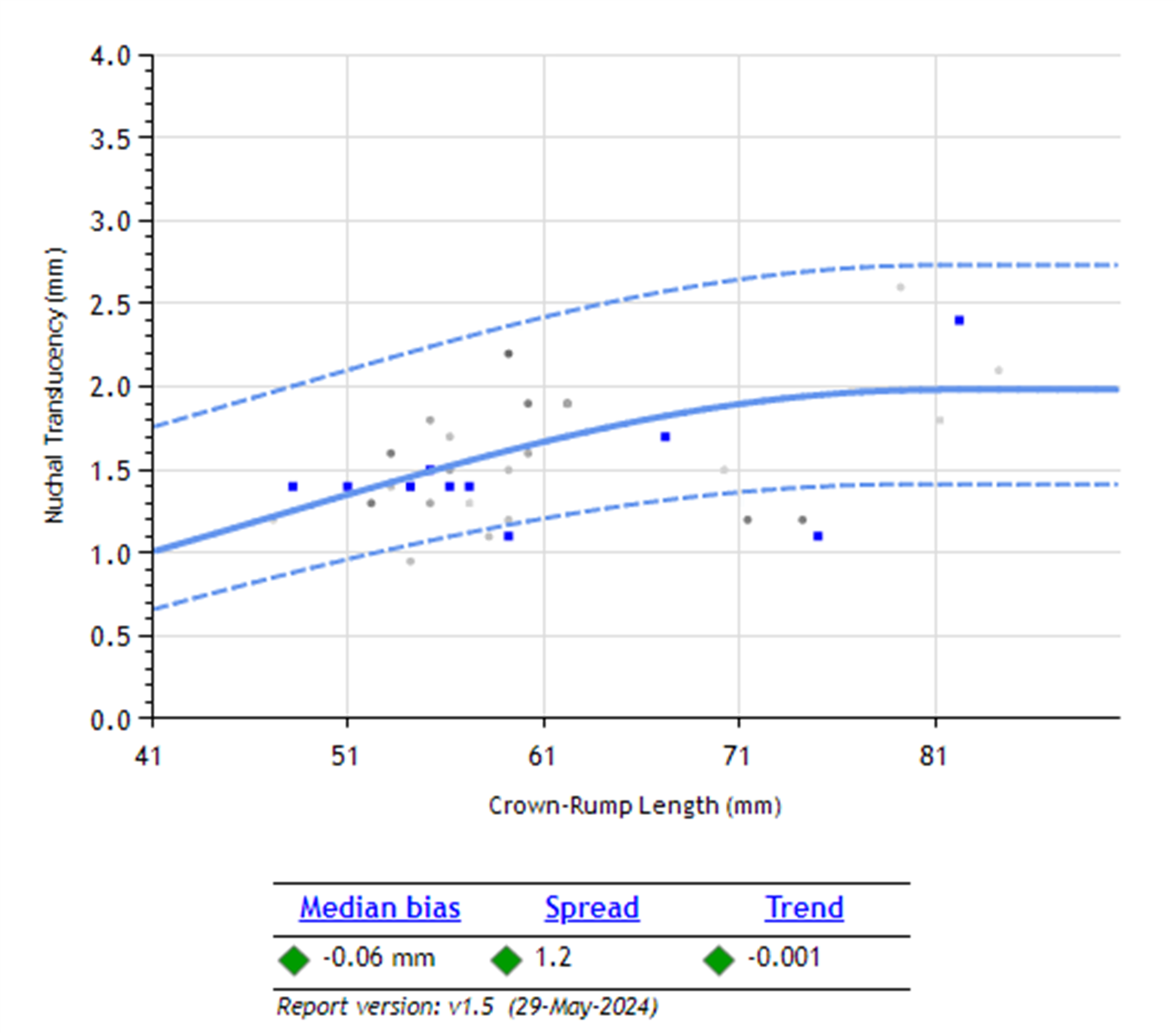
The MMS labs can correlate this data with your Ontario NT ID number and create your personalized NT performance distributions. The distribution will reflect your NT measurement performance when compared against the expected normal population distribution established by the FMF UK.

We encourage you to gain access to your personalized NT performance distribution by logging into the BIS and learn about your scanning habits.

"How to" tips:


Above image shows an example of a personalized NT performance distribution. The NT is on the vertical axis and the CRL is on the horizontal axis. The resulting distribution (grey dots) is compared against the expected NT for gestation as represented by the blue FMF UK curve.


We encourage you to frequently check, interpret your NT performance distribution and make changes to your practice. A proactive approach will help keep your Ontario NT ID number active. 

Contact our clinical content specialist in sonography, Susan Burnett-Roy, at PSO@BORNOntario.ca, for questions or guidance on how to improve your scanning habits.

The Ontario Multiple Marker Screening (MMS) labs may identify you as requiring assistance. This means that you will take part in a formal mentorship program to maintain your NT registration in Ontario. PSO will assess your NT measurement performance by auditing your personalized NT performance distribution data and your NT images. Our goal is to support you through this process and to provide you with actionable feedback that will help you to improve your NT measurement performance. Most of the time, you will maintain an active Ontario NT ID number during this process which means you will continue to be able to perform NT scans. 

Sometimes, the Ontario MMS labs will suspend a sonographers' Ontario NT ID number, which means you will not be able to perform NT scans or submit NT data to the labs for Multiple Marker Screening until you have completed the PSO NT mentorship program.

“The moment a sonographer thinks ‘I don't have anything else to learn’ or ‘What's this person going to teach me?’, it’s time to hang up your probes, because that's a part of our careers. We’re always going to be learning.” 
Katie Virgin, sonographer
(read about her experience in the mentorship program in the BORN 2021-2022 annual report)

Obtaining high-quality NT measurements is important for an accurate risk assessment through multiple marker screening. Currently, the MMS labs use a coefficient for each sonographer based on their performance to adjust pregnant individuals' prenatal screening results and thus maintain a high prenatal screening performance:


Accessible version of above graphic (text only)
  1. Your distribution is assessed - there is a discrepancy between each sonographers' distribution and the standard FMF UK curve
  2. A coefficient is applied - MMS labs apply a coefficient to your measurement to correct for this discrepancy.
  3. High-quality system is maintained - this practice supports a high detection rate for trisomy 21 and 18 in Ontario


The performance distribution is reviewed annually by the MMS labs. If you have shown consistency in your scanning practice, your coefficient will remain the same. Otherwise, the coefficient will be changed based on your current scanning habits and/or you will identified as requiring further assistance to support your practice.


The goal of the NTQA program is to support and improve sonographers' NT scanning practice so that the labs no longer need to rely on this coefficient to maintain a high-quality prenatal screening system.

It's working! Each year since 2017 we have seen an increasing proportion of sonographers who have performance distributions that align with FMF standards, and therefore do not require an adjustment coefficient by the Ontario MMS labs.

Many employers now request that sonographers are registered in the NTQA program. The statement  "As of today’s date, dd-mmm-yyyy, Sonographer code XXXXX is currently registered as an active Nuchal Translucency Sonographer by the Ontario Multiple Marker Screening (MMS) Laboratories." has been added to the individual NT curve of active sonographers. Log into BIS, review your personalized NT performance distribution curve and take a screenshot to provide proof of registration to employers.  

Contact Us

Prenatal Screening Ontario 
CHEO Research Institute 
Centre for Practice-Changing Research Building 
401 Smyth Road 
Ottawa, ON K1H 8L1

pso@bornontario.ca

Information line
Phone: 613-737-2281
Toll-Free: 1-833-351-6490

Monday to Friday, 9:00 AM to 3:00 PM EST

Subscribe to PSO Updates

Subscribe to stay informed about the latest PSO news and prenatal screening updates in Ontario.
Virtual educational sessions on prenatal screening and nuchal translucency quality assurance are available upon request for health‑care providers.