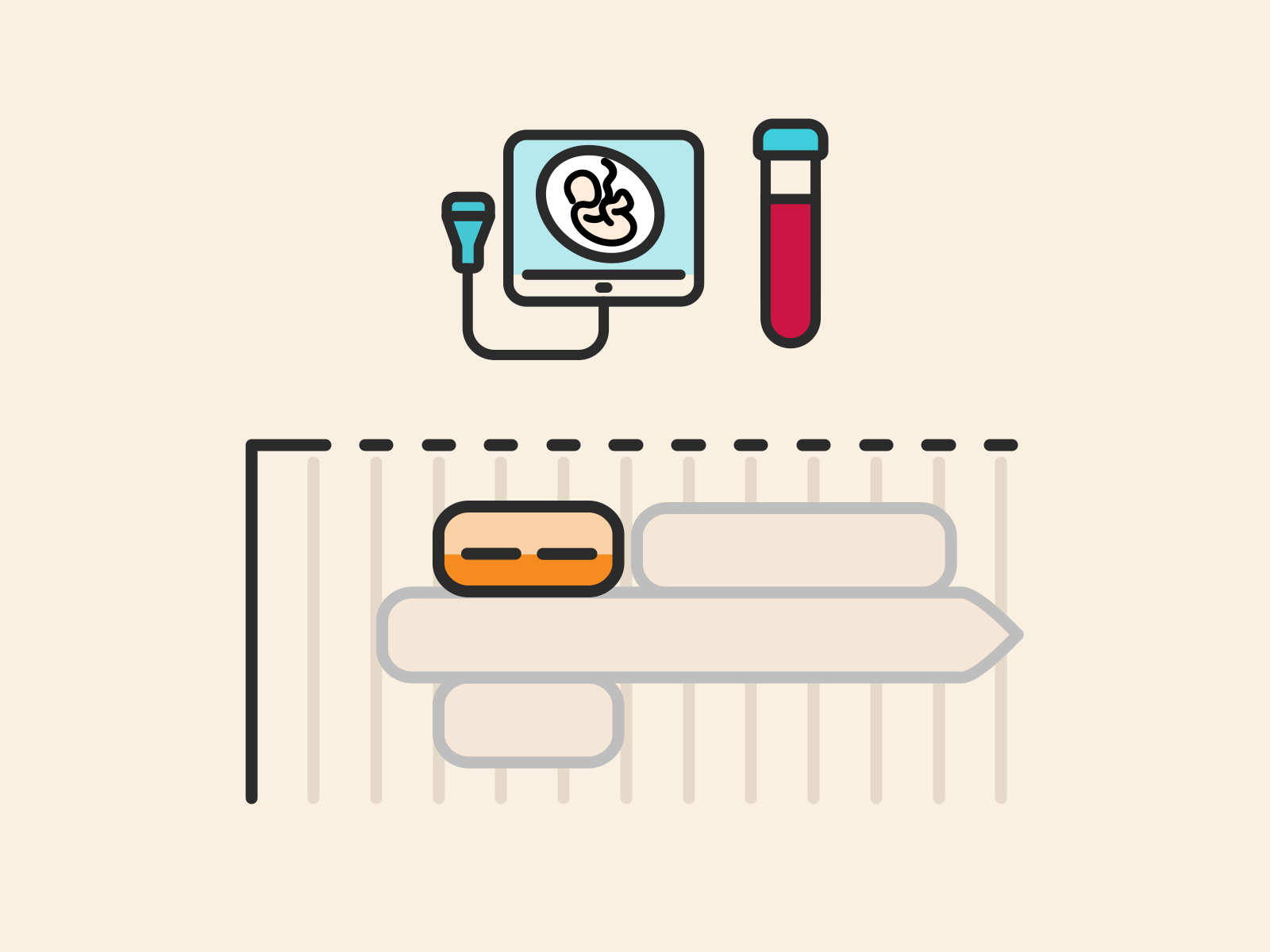
You might have the option of doing another prenatal screening test, called Non-Invasive Prenatal Testing (NIPT), instead of eFTS. In this section, you will learn how eFTS and NIPT compare to help you make a decision.
The results presented in this visual are based on the sensitivity and specificity of eFTS and NIPT from actual Ontario pregnancies with an estimated date of delivery between September 2016 and December 2023 that underwent prenatal screening (twins were excluded). The incidence of trisomy 21 in this group was 1 in 394. The figures were applied to this fictitious population of 50,000 people. View more details about the performance of prenatal screening tests.
Accessible version of above visual (text only)
eFTS and NIPT side-by-side
| Questions to Consider |
eFTS |
NIPT |
| When in the pregnancy is it done? |
Between 11 weeks 2 days and
13 weeks and 3 days
|
After 9 or 10 weeks of pregnancy depending on the laboratory |
| What does it include? |
- 11-14 week (nuchal translucency) ultrasound
- Blood work
|
Blood work
|
| What does it screen for? |
|
- Trisomy 21
- Trisomy 18
- Trisomy 13
- Sex chromosome differences (optional)
|
|
What does it not screen for?
|
Only above conditions are tested. Extra information about the baby's health can be discovered during the 11-14 week (NT) and 18-22 week ultrasounds. |
Only above conditions are tested. A 11-14 week (NT) and 18-22 week ultrasounds are recommended for extra information about the baby's health. |
|
Is it funded by public funds?
|
Yes |
Yes, in certain situations. For example: you are 40 years old at the time of birth or you have a "screen positive" eFTS result. Private-pay is an option if the test cannot be publicly-funded. |
|
What is the chance that the test will fail to give a result?
|
eFTS is only rarely not able to give a result |
Sometimes NIPT fails to give a result or gives a result that is not typical |
|
How accurate is it?
|
Detects most pregnancies with trisomy 21 and trisomy 18. eFTS is less accurate than NIPT |
Detects most pregnancies with trisomy 21 and trisomy 18. NIPT is more accurate than eFTS |
Accessible version of above visual (text only)
Screening tests can give false positive or false negative results.
False positive
A false positive is when a pregnant individual gets a "screen positive" or "high risk" result but the baby does not actually have trisomy 21. Both screens have false positives. However, there are more false positives through eFTS than NIPT.
False negative
A false negative is when a pregnant individual gets a "screen negative" or "low risk" result but the baby actually has trisomy 21 (missed case). Both screens have few false negatives. However, there are more false negatives through eFTS than NIPT.
To help you understand the accuracy of eFTS and NIPT, view the type of results that 50,000 people can get if they choose prenatal screening.
Results of 50,000 people who have eFTS or NIPT
| Type of Result |
eFTS |
NIPT |
| False Positive |
3,162 people (6.3%) get a "screen positive" result, but the baby does not actually have trisomy 21. The bottom line is that most "screen positive" results are false positives. |
35 people (less than 0.1%) get a "high risk" result, but the baby does not actually have trisomy 21. |
| True Positive |
111 people (0.2%) get a "screen positive" result, and the baby does have trisomy 21. |
124 people (0.2%) get a "screen positive" result, and the baby does have trisomy 21. The bottom line is that most people who get a "high risk result" do have a baby with trisomy 21, but there are some false positives. |
| False Negative |
14 people (less than 0.1%) get a "screen negative" result, and the baby does have trisomy 21. |
1 person (less than 0.1%) gets a "low risk" result, and the baby does have trisomy 21. |
| True Negative |
46,713 people (93.4%) get a "screen negative" result, and the baby does not have trisomy 21.The bottom line is that most people who get a "screen negative" result do not have a baby with trisomy 21, but there are some false negatives (missed cases). |
49,840 people (99.7%) get a "low risk" result, and the baby does not have trisomy 21.The bottom line is that most people who get a "low risk" result do not have a baby with trisomy 21. |