Non-Invasive Prenatal Testing (NIPT)

Non-invasive Prenatal Testing (NIPT) is the most accurate prenatal genetic screening test and may be publicly-funded or private-pay depending on your situation. There is no risk to the pregnancy because it is done through blood work. NIPT can tell you the chance for having a baby with trisomy 21 (Down syndrome), trisomy 18 (Edwards syndrome) and other chromosome differences. You can have NIPT from the time you are 9 or 10 weeks pregnant until the end of the pregnancy. 

For health-care providers

NIPT Requisitions

Requisitions needed to order publicly-funded Non-Invasive Prenatal Testing (NIPT):

NIPT Funding

In some situations, the cost of NIPT is covered by public funds. If you don’t qualify for publicly-funded NIPT, you can choose to pay for it yourself. Review your options on the NIPT Funding Criteria page.

Talk with your health-care provider if you would like to get NIPT. In Ontario, this test can be ordered by:

  • doctors (such as family doctors, obstetricians)
  • nurse practitioners
  • midwives

Your health-care provider may tell you about the option of going to a genetics centre for more discussion if there are concerns about your pregnancy.

You should not have NIPT if you:

You can choose NIPT as the only prenatal genetic screening test in your pregnancy.

If you decide to have NIPT from the start, you do not need another screening test (such as eFTS). You should still be offered a 11-14 week (nuchal translucency) ultrasound on its own to get more information about the health of the baby.

Another option is to start with another publicly funded screening test, such as eFTS. Later in the pregnancy, you can think about having NIPT.

NIPT detects most pregnancies with trisomy 21trisomy 18 and trisomy 13. As other screening tests, NIPT cannot detect all pregnancies with these chromosome differences. 

Talk to your health-care provider about screening your pregnancy for sex chromosome differences including Turner syndrome.  This extra test is optional. Keep in mind the accuracy of NIPT for sex chromosome differences is thought to be lower. 

You may be told you can have screening for a group of conditions called microdeletion syndromes as an extra private-pay option. Each microdeletion syndrome is rare on its own and the accuracy of NIPT for these conditions is difficult to study.  So far, we know that NIPT might not be as accurate for these extra conditions.  

Microdeletion syndromes can vary a lot in severity from person to person. It may be difficult to know how these conditions might affect your pregnancy or your baby after birth. 

Current guidelines do not support the use of NIPT to screen for microdeletion syndromes at this time. This may change as more studies are done.

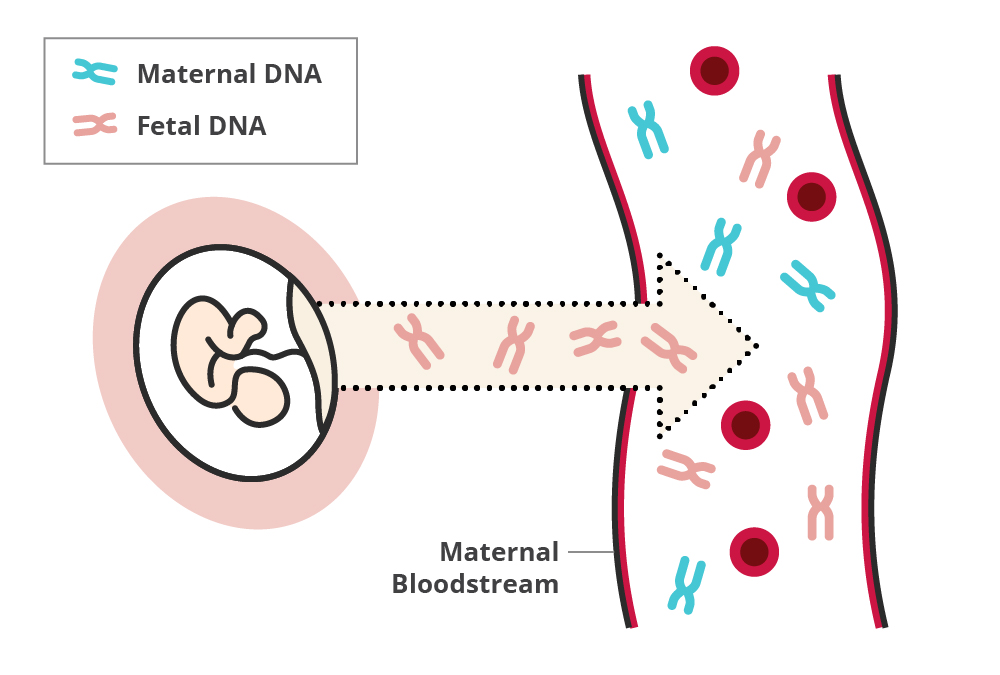
During a pregnancy, your baby's placenta releases small pieces of genetic material (known as DNA) into your blood stream. NIPT looks at this placental DNA and can tell you the chance for the baby to have one of the chromosome differences that are tested.


Illustration adapted from Genetic Counseling Aids, 7th Edition, Copyright 2020, permission for use granted by Greenwood Genetic Center


It takes about 7 to 10 business days for your health-care provider to get the NIPT results. If NIPT was done through LifeLabs, you may be able view your results online within 5 calendar days of the report being released to your health-care provider.

When you get your NIPT report, it will most likely say that you have a “low risk” result. This means there is a very low chance that the baby has one of the screened conditions.

Some people will get a “high risk” result. This means there is a high chance that the baby has one of the screened conditions. More testing would be offered to you, including diagnostic testing.

Sometimes, NIPT does not give a result. This is usually due to reasons you can’t control. Having an ultrasound before the blood draw can help reduce this chance. The ultrasound checks if it’s the right time for the test and if you’re expecting more than one baby. 

Some pregnancies happen through in vitro fertilization (IVF) and the embryos may get Preimplantation Genetic Testing for Aneuploidy (PGT-A) during that process.  PGT-A involves screening embryos for chromosome differences, including trisomy 21 and trisomy 18. It is a very good screen, but not diagnostic.  If your pregnancy was screened using PGT-A, you can see a genetic counsellor to talk about the benefits and limitations of having NIPT in your situation.

Benefits 


There are three main benefits of NIPT:

Higher Accuracy

NIPT is a more accurate screening test compared to other screening tests (eFTS or STS).

Earlier Timing

NIPT can be done earlier than other available screening tests.

Safe

As other screening tests, NIPT poses no risk to the pregnancy.

Limitations


NIPT has some of the following limitations:

Not Diagnostic

NIPT is a very good screening test but it still cannot give a definite “yes” or “no” answer. Only diagnostic testing (such as chorionic villus sampling or amniocentesis) can do that.

Does not screen for "everything"

A "low risk" result does not guarantee the birth of a healthy baby.

May not work

Occasionally, the NIPT doesn't give a result. You might not get a result for any of the chromosome differences that were tested. Or, only the testing for sex chromosome differences might fail.

This only rarely happens with other prenatal genetic screening tests (eFTS and STS).

Can give you an unexpected result or a result that is not typical

Even more rarely, you can get an unexpected result. For example, NIPT may pick up a difference in your own genetic material. You should talk about this type of result with a genetic counsellor.

Subscribe to PSO Updates

Subscribe to stay informed about the latest PSO news and prenatal screening updates in Ontario.
Virtual educational sessions on prenatal screening and nuchal translucency quality assurance are available upon request for health‑care providers.