Second Trimester Screening (STS) Guide


Second Trimester Screening (STS) is a screening test for trisomy 21 and trisomy 18 consisting of bloodwork in the second trimester of pregnancy. This test is offered to individuals who missed the time window for enhanced First Trimester Screening (eFTS) or if a nuchal translucency (NT) ultrasound is not available in their area. 

Step-by-step instructions are outlined below, to provide guidance to health-care providers for how to order this test in Ontario.

Maternal Serum Screening (MSS) has been renamed “Second Trimester Screening” or STS. This change applies to the name only to improve understanding of when in pregnancy this screening can be done. The timing and analytes for this screen remain unchanged.

Maternal serum alpha-fetoprotein (MS-AFP) is no longer necessary to routinely screen for open neural tube defects (ONTD), unless there is a barrier to a good quality ultrasound examination.  

Step 1
Complete the Multiple Marker Screening Requisition

Multiple Marker Screening (MMS) is done by three provincial laboratories: Trillium Health Partners - Credit Valley Hospital, Mount Sinai Hospital and North York General Hospital. Check out our interactive map to learn which of the three requisitions you should use. 

Demographics Section

Document the pregnant individual’s name, date of birth, health card number, address, and phone number.

"Test Requested" Section

Check off the Second Trimester Screening (STS) option only for:

  • Singleton pregnancies, with or without vanishing twin/co-twin demise. In a vanishing twin/co-twin demise scenario, note that blood draw must be done at least 8 weeks after the demise of the twin. STS cannot be done for viable twin pregnancies - offer publicly funded NIPT instead.  
  • Pregnancies that are in the gestational time window of 14 weeks 0 days to 20 weeks 6 days. The gestational age is determined either by ultrasound or LMP. Ultrasound is the preferred method of dating.
  • Pregnancies for which NIPT has not been ordered.
  • Pregnancies for which NIPT has been ordered, but has been uninformative.

 "Clinical Information" Section

Accurate and complete information in this section will increase the quality of the screening results by reducing the chance of false positives and false negatives. 

Example of statement you can make when speaking with pregnant individuals:

  • I have some questions about you to ask to make sure your screening is as accurate as possible.

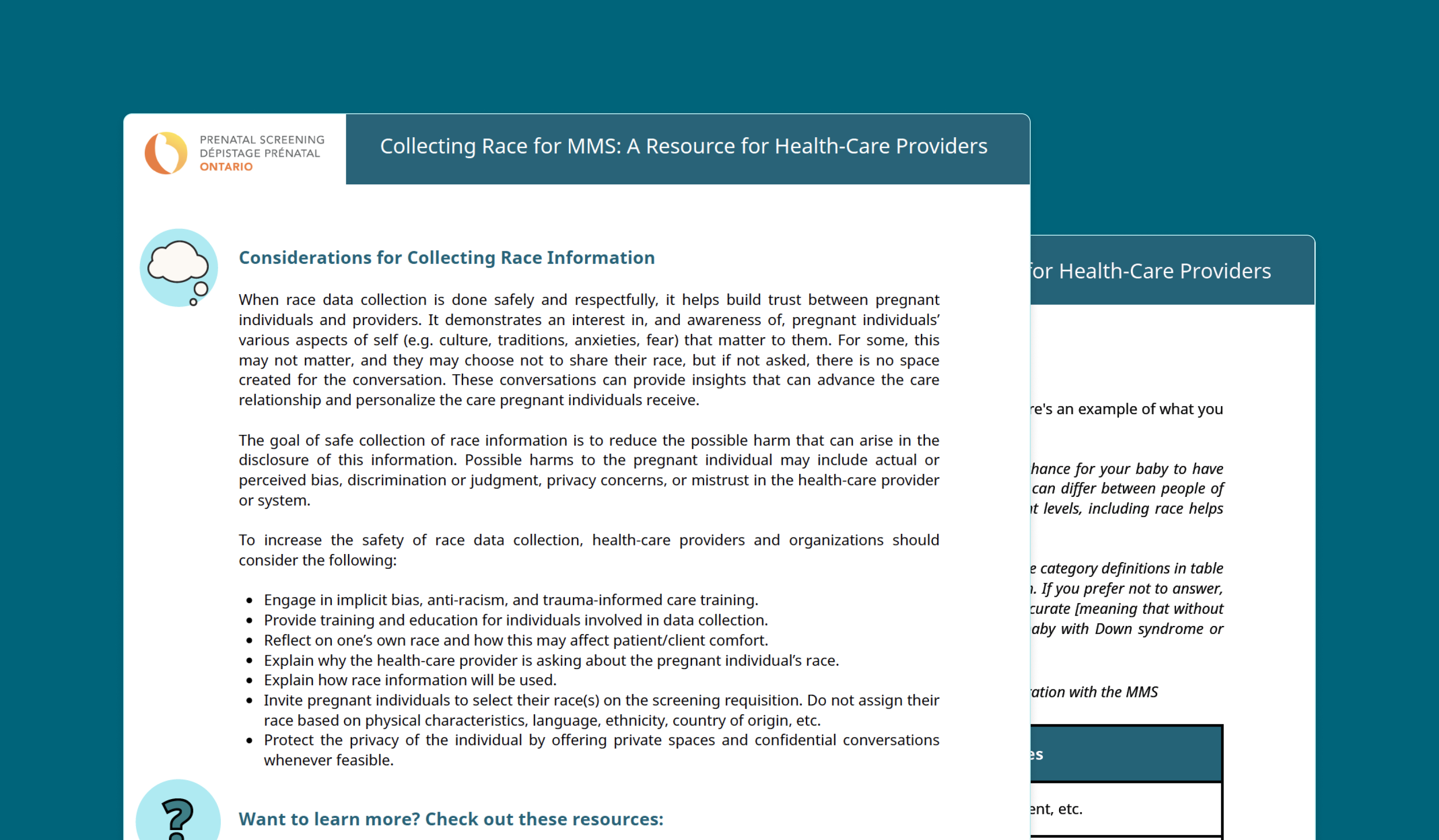
Race is a way of grouping people based on biological traits like skin colour, hair texture, language, or where they are from. It is a social construct, meaning these groups were created by humans. Examples of race categories are: Asian, Black, Middle Eastern, White, among others. While race is sometimes used as a proxy (or a stand-in) for ethnicity or genetic ancestry, these terms differ in definition. Ethnicity generally refers to social and cultural categories, whereas genetic ancestry refers to genetic origins. 

Why is race collected? 

Race is collected because studies have shown that the baseline (or starting) concentration of the serum markers used in MMS differ between races. Therefore, the screening algorithm makes adjustments based on the pregnant individual’s race, with the goal to make screening more accurate for everyone.   

It is important to remember that race itself, as a social construct, is not responsible for the observed differences in serum marker concentrations. As we learn more about what truly causes the differences (e.g.  social and structural factors, the impact of structural racism, and the biology behind the markers, including genetic ancestry), and, as we learn more about the experience of reporting one’s race, the approach may evolve. For now, race is being collected and used as a proxy for these unknown root causes.

How should race be collected? 

Ideally, the pregnant individual self-reports their race on the requisition by checking all categories that apply or writing another race. Health-care providers should not choose a race for them. Refer to the table below for definitions of each race category. 

Is sharing race mandatory? 

Pregnant individuals can decline to report their race information and screening can still be done; however, the accuracy of the screening may be affected. Without race information, the calculated risk may over- or underestimate the true chance for the baby to have Down syndrome or trisomy 18. 

Where is race data stored? 

Race data is used in the screening software and included in the report for the ordering health-care provider. This information is also shared with BORN Ontario and is protected by law. 

What if the race information needs to be corrected or if an individual wants it removed? 

If the race on the screening report is not accurate, the health-care provider can contact the screening laboratory for further information. Sometimes, certain races are grouped into an overall category to be used in the screening algorithm, which means a person’s exact race might not be on the report but rather, a broader category. It is recognized that broad race categories are not ideal and do not reflect the diversity of individuals, yet this is a limitation of the screening software currently. 

Other times, the wrong race may in fact have been reported on the requisition. In this case, the laboratory can usually correct this information and issue a new report.  

If a pregnant individual would like their race removed entirely from the screening report, the laboratory would categorize the individual in the “other” grouping. This might affect the accuracy of the screening result.  


Table 1. Current racial groups that are collected for MMS. *PSO, in collaboration with the MMS laboratories, is exploring the ability to expand the racial categories collected 

Race Category

Description/examples

Black 

African, Afro-Caribbean, African-Canadian descent, etc. 

Asian  

Central Asian (Kazakhstan, Turkmenistan, Uzbekistan, Kyrgyzstan and Tajikistan and other Central Asian descent) 


East Asian (Chinese, Korean, Japanese, and other East Asian descent),  


South Asian (Afghanistan, East Indian, Pakistani, Bangladeshi, Sri Lankan, Indo-Caribbean, etc.) 


Southeast Asian (Filipino, Vietnamese, Cambodian, Thai, Indonesian, other Southeast Asian descent) 

Indigenous:
- First Nations
- Métis
- Inuk/Inuit

First Nations, Métis, Inuit descent 

White

European descent 


Middle Eastern (Arab, Persian, West Asian descent, e.g. Afghan, Egyptian, Iranian, Lebanese, Turkish, Kurdish, etc.)  

Other 

Another race category (write in response) 

Indicate the pregnant individual’s weight, including units (pounds (lbs) versus kilograms (kg)), at the time when this requisition is completed. This information is used for screening marker adjustments. A weight discrepancy of 10 or more pounds (4.6 kilograms) has a significant impact on the risk for trisomy 21 for pregnant individuals with a risk close to the screening cut-off.

Example of questions you can ask pregnant individuals if the weight is not obtained at the time of appointment:

  • What do you think is your current weight? 
  • Do you think the weight your provided is accurate within 5 pounds? 

Indicate the first day of the pregnant individual's Last Menstrual Period (LMP). In the absence of valid ultrasound information, this information will be used to establish the gestational age of the pregnant individual.

Indicate if insulin-dependent Diabetes Mellitus was diagnosed prior to the individual’s current pregnancy. Individuals with insulin-dependent Diabetes Mellitus have been shown to have different concentrations of screening markers compared to those who do not have this diagnosis. Screening marker adjustments must be made to account for these differences.

No screening marker adjustments are made for pregnant individuals with a history of gestational diabetes or preexisting diabetes that is not managed with insulin.

Example of questions you can ask pregnant individuals:

  • Do you have a diagnosis of diabetes? 
  • Was the diabetes diagnosed before the current pregnancy?
  • Do you use insulin to manage the diabetes? 

Indicate if the pregnant individual has smoked or vaped any amount of nicotine at any point in the current pregnancy. Individuals with a history of smoking or vaping nicotine have been shown to have different concentrations of screening markers compared to those who do not have this history. Screening marker adjustments must be made to account for these differences. 

If the requisition does not include information about the smoking or vaping history, the pregnant individual is considered a non-smoker. Due to lack of published data, pregnant individuals exposed to second-hand smoke are considered non-smokers. 

Example of question you can ask pregnant individuals:

  • Have you smoked any cigarettes or used a nicotine vaping device at any point in the current pregnancy? 

If the pregnancy was conceived using in vitro fertilization (IVF), indicate the egg retrieval date and date of birth of the egg donor (either self or non-self). If the egg donor's full date of birth is unknown, indicate the year of birth. If only the year of the donor date of birth is provided, July 1 of the provided year is used as the date.

This information is requested because the age of the egg at the date of delivery influences the screening risk. In addition, screening marker levels vary between IVF and natural conceptions and screening marker adjustments must be made to account for these differences.

Examples of questions you can ask pregnant individuals:

  • Did the current pregnancy happen through in vitro fertilization (IVF)? 
  • What was the egg retrieval date?
  • Were your own eggs used for this pregnancy, or was there an egg donor involved? 
  • Do you know the date of birth of the egg donor; at minimum, the year of birth? 

"Ultrasound Information" Section

Be aware that for STS, you, as the ordering health-care provider, fills out this section of the requisition. If available, record ultrasound information. Although ultrasound is not required, it is recommended that it is done prior to STS whenever possible. Ultrasound establishes the gestational age more accurately than LMP, and determines the number of fetuses, therefore improving the quality of the screen.

Step 2
Provide Requisitions to the Pregnant Individual

  • Give the completed Multiple Marker Screening requisition to the pregnant individual. 
  • Check if additional requisitions are required by the ultrasound and blood work facilities, such as the Ministry of Health and Long Term Care Laboratory Requisition.

Step 3
Provide Step-by-Step Instructions to the Pregnant Individual

Provide the pregnant individual with instructions for how to get STS. Confirm that the pregnant individual is aware of the time window when STS can be done and that the blood draw can be performed at any hospital or community blood collection laboratory.

Step 4
Obtain Report and Check for Accuracy

  • Results are reported to you by the MMS lab generally within 5 business days. It is important to take into account the time lag that can occur between the time when the report is ready and when it is received by your office.
  • If you do not receive the prenatal screening report, we encourage you to follow up with the MMS lab directly. Prenatal Screening Ontario does not have access to screening results of individuals. 
  • Review the screening report for accuracy. If any errors or omissions are noted, contact the MMS Laboratory to determine if an amendment to the report is needed.

When is a Report Amended?

A report is considered “amended” if changes are made after the report has been issued to the health-care provider. Amending reports is necessary to correct errors that include data being inaccurately provided on the requisition. 

It is ideal that gestational age information from a dating ultrasound is used on the MMS requisition (instead of the LMP). Sometimes, the ultrasound information is not included, or the ultrasound occurs after the report is already issued. Amendment of gestational age is made only if the gestational age derived from an ultrasound is found to differ by 10 days or more from the gestational age determined by LMP.

Other indications for amendment are inaccurate racial origin identification, inaccurate diabetes status, and correction of weight, due to either wrong units (i.e. pounds or kilograms) or difference in weight of more than 5 - 10 pounds (2.3 - 4.6 kilograms)1 from that given on the requisition.

1North York General Hospital and Mount Sinai Hospital labs will amend a report if there is a difference in weight of more than 10 pounds. The Trillium Health Partners lab will amend a report if there is a difference in weight of more than 5 pounds. 

How is a Report Amended?

Health-care providers can write the amendment(s) directly on the screening report and fax it back to the Multiple Marker Screening Laboratory, indicating that an amendment is required as per the enclosed report. Alternatively, health-care providers can fax a note with the pregnant individual's name, date of birth, health card number, and details related to the amendment request including relevant clinical information. 

Step 5
Communicate Results and Next Steps

  • Once the report is received, results should be communicated to the pregnant individual in both “screen positive” and “screen negative” scenarios, including the specific risk estimate provided on the report.
  • Ensure continuity of care - forward the report to any other health-care providers involved in the care of the pregnant individual.
Back to News Search

Contact Us

Prenatal Screening Ontario 
CHEO Research Institute 
Centre for Practice-Changing Research Building 
401 Smyth Road 
Ottawa, ON K1H 8L1

pso@bornontario.ca

Information line
Phone: 613-737-2281
Toll-Free: 1-833-351-6490

Monday to Friday, 9:00 AM to 3:00 PM EST

Subscribe to PSO Updates

Subscribe to stay informed about the latest PSO news and prenatal screening updates in Ontario.
Virtual educational sessions on prenatal screening and nuchal translucency quality assurance are available upon request for health‑care providers.