Alloimmunized Fetal Blood Group Genotyping (Allo-FBGG)

If you have been told that you have anti-D, anti-C, anti-c, anti-E or anit-K (Kell) antibodies, Alloimmunized Fetal Blood Group Genotyping (Allo‑FBGG) can check if your baby has the matching marker (called an antigen) on their red blood cells that your antibodies react to.

The results help your health-care provider understand if your pregnancy needs monitoring for a condition called hemolytic disease of the fetus and newborn (HDFN).

This test is publicly funded for pregnant people living in Ontario.

For Health-Care Providers

Allo-FBGG Requisition

Allo-FBGG is performed by the Sinai Health Diagnostic Medical Genetics Laboratory in Toronto, ON.

Talk to your health-care provider to see if Allo-FBGG is right for you. In Ontario, this test can be ordered by:

  • doctors (such as family doctors, obstetricians)
  • nurse practitioners
  • midwives

If you don’t have a family doctor, you can still arrange this test through a walk-in clinic. Use Health811 to find walk-in clinics near you. 

Allo-FBGG can be done from 16 weeks of pregnancy depending in the antibodies you have.

Your health-care provider will give you a requisition for this test. Take your requisition to your local laboratory to have your blood drawn. The laboratory will then send your sample to Sinai Health for testing.

Not sure where to get your blood drawn?  Use the following links to find a lab near you: 

Find a Specimen Collection Centre – Ontario Association of Medical Laboratories: OAML
AlphaLabs - AlphaLabs

Allo-FBGG is publicly funded for pregnant people living in Ontario who have one or more of these antibodies:

  • anti-D
  • anti-C
  • anti-c
  • anti-E
  • anti-K (Kell)

Allo-FBGG should NOT be done if you :

  • do not have anti-D, anti-C, anti-c, anti-E or anti-K (Kell) antibodies
  • have antibodies other than anti-D, anti-C, anti-c, anti-E or anti-K (Kell)
  • started your pregnancy with more than one baby and one was lost (known as a fetal demise or vanishing twin)
  • have anti-D antibodies that have been confirmed to be passive (for anti-D only)
  • have a known RHD variant or weak D blood type (for anti-D only)

Allo-FBGG timing depends on the antibodies that you have:

  • anti-D, anti-C, anti-c and anti-E can be tested from 16 weeks in your pregnancy
  • anti-K (Kell) can be tested from 20 weeks in your pregnancy

Allo-FBGG is used to determine if your baby has the matching marker (called an antigen) on their red blood cells that your antibodies react to. At present, Allo-FBGG can only look for antigens that anti-D, anti-C, anti-c, anti-E or anti-K (Kell) antibodies react to.

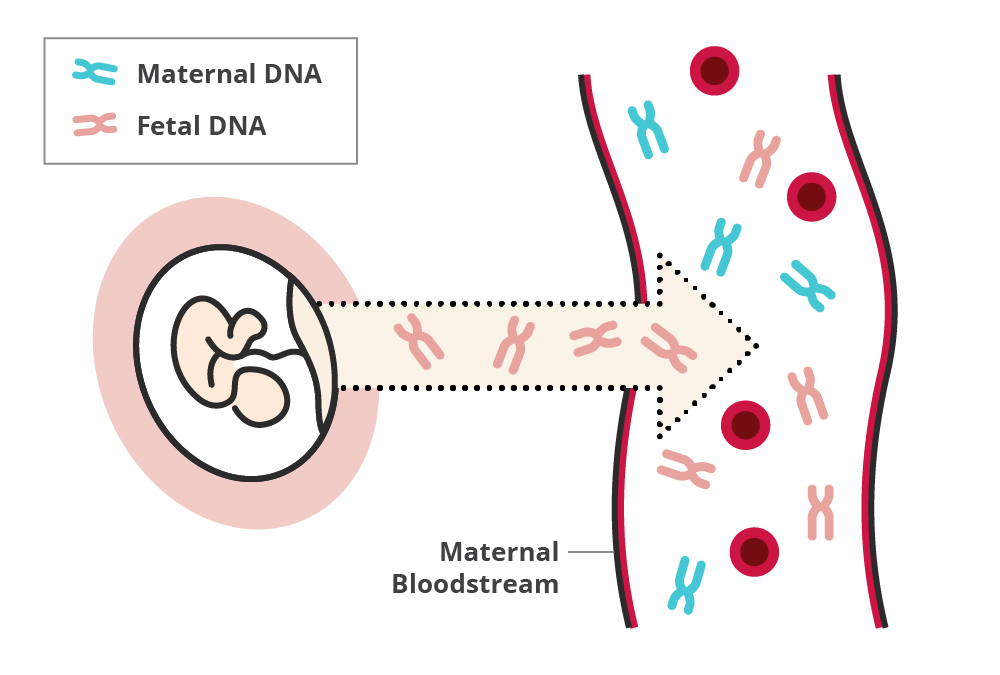
During pregnancy, your baby's placenta releases small pieces of genetic material (known as DNA) into your blood. Allo-FBGG test uses a blood sample from you to look at this placental DNA to determine if your baby has the antigen that your antibody can react to.


Illustration adapted from Genetic Counseling Aids, 7th Edition, Copyright 2020, permission for use
granted by Greenwood Genetic Center.

Results are usually ready within 10 business days and are sent to your health-care provider.
Talk to your health-care provider about how they plan to give you these results. 

If your health-care provider does not receive the results within this time, they are encouraged to contact the testing laboratory: 

Sinai Health
Diagnostic Medical Genetics, Pathology and Laboratory Medicine
Tel: (416) 586-4800 x 5974
Fax: (416) 619-5532
FBGG.MSH@sinaihealth.ca 

Allo-FBGG result is "Positive"

Allo-FBGG result is "Negative"

Your baby has the blood group antigen tested for and is at risk of hemolytic disease of the fetus and newborn (HDFN). Your health-care provider will discuss monitoring for your pregnancy.

Monitoring may include:
  • blood tests to check the antibody levels in your blood
  • specialized ultrasounds to measure blood flow to the baby
  • referral to a maternal-fetal medicine (MFM) specialist
Your baby does not have the blood group antigen tested for and is not at risk of HDFN. No change to your prenatal care is needed. Your health-care provider will continue to provide routine prenatal care.


Sometimes the test cannot give a result. This is called a "Failed" or "Inconclusive" result.  Another blood sample may be requested to repeat the test, or it may be recommended to treat your pregnancy as if your baby has the antigen and provide closer monitoring.

Learn more about Fetal Blood Type Screening Results & Next Steps

After delivery, a small blood sample will be collected from the umbilical cord to confirm your baby’s antigen status. The results may be used to guide newborn care and may be shared with the testing laboratory for quality checks.

Watch the Alloimmunized Fetal Blood Group Genotyping Information Video

Download the Fetal Blood Group Genotyping for Alloimmunized Pregnancies Information Guide for Providers

Download the Fetal Blood Group Genotyping for Alloimmunized Pregnancies Information Guide for Pregnant Individuals

PSO Infoline

Our genetic counsellors and screening specialists are available Monday to Friday from 9:00 am - 3:00 pm EST to answer your questions about prenatal screening.

Please note that prenatal screening tests have to be ordered through a health-care provider, and we cannot organize this testing.

Subscribe to PSO Updates

Subscribe to stay informed about the latest PSO news and prenatal screening updates in Ontario.
Virtual educational sessions on prenatal screening and nuchal translucency quality assurance are available upon request for health‑care providers.